Table of Contents1. Introduction |
|
Introduction
Service-based businesses work very differently from product-based businesses. Instead of selling items, they sell time, skills or completed work. Because of this, creating invoices and applying GST correctly often becomes confusing in that case. Manual billing increases the chances of errors, delays and compliance issues. This is why many service providers rely on GST billing software to manage their invoicing smoothly. It helps automate calculations, maintain proper records and reduce stress related to GST compliance.
What Is Time-Based GST Billing
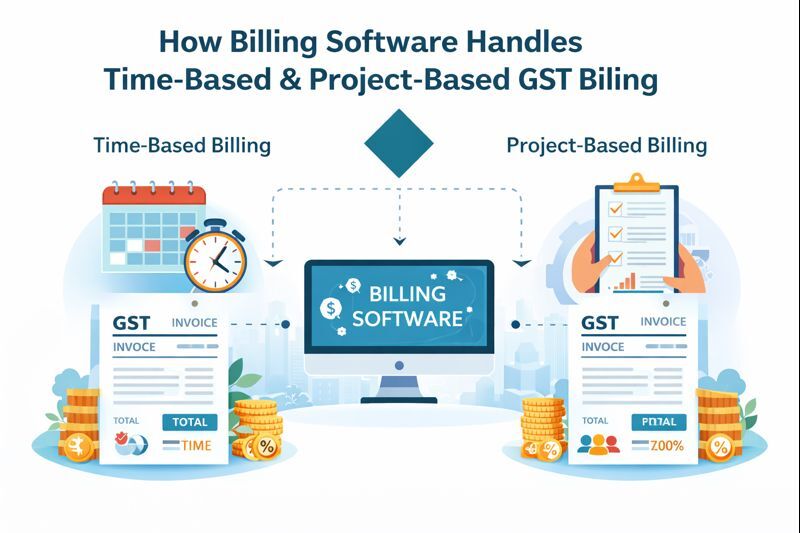
Time-based billing means charging customers according to the amount of time spent delivering a service. This model is commonly used by consultants, freelancers, legal professionals, accountants and IT service providers. The total invoice value depends on the number of hours or days worked and the agreed rate.
In time-based GST billing, tax is calculated on the final service amount derived from time spent. Billing software makes this easy by tracking billable time, calculating the payable amount automatically and generating accurate invoices without the need for manual effort.
What Is Project-Based GST Billing
Project-based billing is used when a service is offered as a complete project rather than hourly work. Examples include website development, branding projects, marketing campaigns or interior design services. Payments may be taken as a single amount or broken into milestones.
With project-based GST billing, GST is charged on the total project value or on individual milestone payments. Billing software helps to manage project details, keeps track of billing stages and makes sure that the invoices are raised correctly at every step.
GST Applicability on Time-Based and Project Billing
GST is applicable to both billing models when services fall under taxable categories and the business is registered under GST. The tax rate depends on the nature of the service. Each invoice must include required details such as GSTIN, service description, taxable amount and tax breakup.
Using GST invoicing software ensures all invoices follow GST rules properly. It minimizes compliance risks and helps businesses to avoid mistakes that can lead to notices or penalties.
Benefits of Using Billing Software for Service Businesses
-
● Simplifies invoice creation
Invoices can be created quickly without manually entering calculations which reduces workload and confusion.
-
● Ensures accurate tax calculation
The system calculates tax automatically based on invoice value which helps to avoid undercharging or overcharging GST.
-
● Tracks work details efficiently
Time logs, project stages and billing data remain well-organized in one place.
-
● Reduces human errors
Automation minimizes mistakes that often happen due to manual entries or formula errors.
-
● Saves valuable time
Less time is spent on billing tasks which allows business owners to focus more on clients and growth.
-
● Improves compliance confidence
Invoices are generated in proper formats which help businesses to stay aligned with GST regulations.
-
● Supports professional documentation
Clean and clear invoices help to improve trust and transparency with clients.
-
● Helps manage multiple clients easily
Businesses can handle several projects or customers can manage billing without confusion.
-
● Makes audits and filing easier
Organized records help during GST returns, audits and financial reviews.
-
● Scales with business growth
As service volume increases, billing remains smooth without adding extra manual effort.
Conclusion
Billing for services requires careful handling of time, project values and GST rules. Managing this manually can slow down operations and increase the risk of errors. With the right billing solution, service businesses can automate invoicing, maintain accuracy and stay compliant with ease. This not only improves financial control but also allows business owners to focus on delivering quality services and growing their business confidently.