Table of Contents1. Introduction |
|
Introduction
Every business owner who's dealt with GST return filing knows the drill - you're busy running the actual business, and then suddenly it's the 20th of the month and you're scrambling to pull invoices together. Most of the trouble doesn't come from GST being complicated. It comes from the same small mistakes repeating every single month, quietly, until they turn into a notice or a blocked credit.
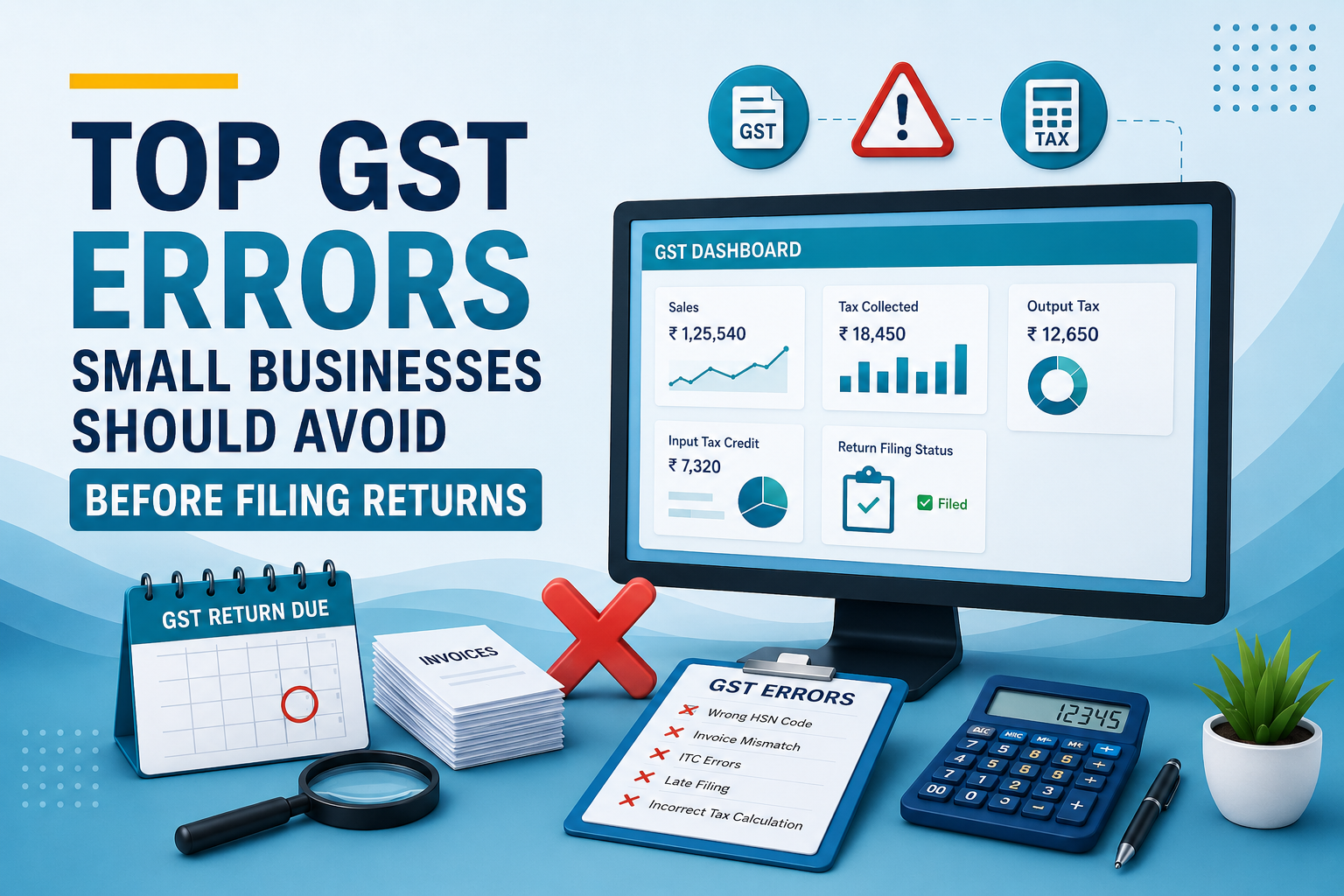
Below are the errors that come up again and again during GST filing, and honestly, most of them are fixable with just a bit more attention.
GSTR-1 and GSTR-3B Not Matching
This is probably the number one issue. A GSTR-1 and GSTR-3B mismatch happens more often than people admit - an invoice gets left out, a figure gets typed wrong, or sales get reported in the wrong period.
-
● The GST system is good at spotting these gaps, and once it does, you're looking at a notice, and possibly your input tax credit getting stuck.
-
● The fix isn't complicated, just tedious - sit down and reconcile both returns before you file, every month, not just when something goes wrong.
Sloppy Invoices
You'd be surprised how many GST filing errors trace back to a badly made GST invoice. A missing GSTIN, a wrong HSN code, tax charged at the wrong rate, invoice numbers out of sequence - these seem minor when you're creating the invoice, but they cause real problems later when everything's being cross-checked.
Get your invoicing template right once, and this problem mostly disappears on its own.
Getting Input Tax Credit Wrong
Input tax credit is meant to work in your favor, but it's also where a lot of businesses trip up.
-
● Some claim ITC on expenses that don't even qualify.
-
● Others claim it before the supplier has filed their own return.
-
● And a lot of people just don't bother checking GSTR-2B before filing - they go by memory or estimate, which is never a good idea with tax filings.
-
● Match your claims against GSTR-2B every time. It takes a few extra minutes and saves a lot of trouble.
Missing the Deadline, Again
It sounds too basic to mention, but late filing remains one of the common GST mistakes small businesses keep making.
-
● Once you miss the date for GSTR-3B filing, the clock starts on both late fees and interest, and it doesn't wait for you to catch up.
-
● Right now, the GST late fee works out to ₹50 a day for GSTR-1 and GSTR-3B, split as ₹25 CGST and ₹25 SGST, with nil returns charged a lighter ₹20 a day.
-
● That's before interest even kicks in and unpaid tax carries 18% annual interest, which jumps to 24% if you've over-claimed ITC or under-reported your tax liability.
-
● These amounts are capped depending on your turnover, but if you're consistently late, it adds up faster than most people expect.
A reminder set a week before the due date - not on the day itself - makes a real difference here.
Underestimating the GST Penalty
A lot of business owners think a late fee is the worst that can happen. It's not. Keep missing filings and you start running into bigger problems - e-way bill generation gets blocked, and in serious cases, your ability to file at all gets restricted. A GST penalty isn't just a number on a challan; it can genuinely disrupt how you run the business day to day.
If you've fallen behind on more than one return, don't try to clear everything randomly. Start with the oldest pending one first - that's where the fees and interest have been quietly stacking up the longest.
Leaving Records for the Last Minute
GST compliance isn't really a once-a-month event, even though it feels that way. The businesses that struggle the most are usually the ones pulling invoices and expense records together the night before filing. Rushed work means missed entries, and missed entries mean errors that carry into the next period too.
Keeping even a basic spreadsheet updated weekly - nothing fancy - makes filing week a lot less stressful.
Filing Without a Final Check
And then there's the simplest mistake of all: hitting submit without reviewing the return first. Once it's filed, fixing things isn't always straightforward, and small errors have a way of following you into the next month's filing.
Give yourself five minutes before submission to check the totals, the tax breakup, and the ITC figures. It's a small habit that prevents a lot of headaches.
Conclusion
None of this is really about mastering tax law. GST return filing goes smoothly when invoicing, reconciliation, and deadlines become routine instead of something you deal with in a panic once a month. Most GST mistakes aren't complicated - they're just the result of rushing. Staying consistent with GST compliance protects your cash flow, keeps your input tax credit intact, and keeps you well away from GST penalty trouble down the line.
Frequently Asked Questions
Q1. What causes most GST notices for small businesses?
Usually a GSTR-1 and GSTR-3B mismatch, followed closely by input tax credit claims that don't match GSTR-2B.
Q2. What's the current GST late fee?
₹50 per day for GSTR-1 and GSTR-3B, split evenly between CGST and SGST. Nil returns are charged ₹20 per day, and both are capped based on turnover.
Q3. Is it okay to claim input tax credit without checking GSTR-2B first?
Not really - it's one of the fastest ways to end up with a mismatch or a credit reversal later.
Q4. What happens if I keep missing GST deadlines?
Beyond late fees and interest, you risk e-way bill restrictions and, eventually, filing blocks.
Q5. How often should returns be reconciled?
Monthly is ideal. Leaving it for year-end usually means bigger, harder-to-fix errors.