Table of Contents1. Introduction |
|
Introduction
Ask any small business owner in India about GST invoices and you'll probably get a tired sigh before an answer. On paper, the GST invoice format sounds simple enough - just a bill with some tax details. In practice? People mess it up all the time. Wrong HSN code, missing GSTIN, forgetting to mention place of supply - small errors that create big headaches later during filing or audits.
So let's actually walk through this properly, the way you'd explain it to a friend who just started a business and has no clue where to begin.
Why the Invoice Format Actually Matters
A GST invoice isn't just a piece of paper (or PDF) you hand over after a sale. It's proof that the transaction happened, it tells the government how much tax was collected, and for the buyer, it's often their ticket to claiming input tax credit. If your invoice is messy or missing details, that credit can get stuck and nobody likes chasing that kind of paperwork.
That's the whole reason a proper GST tax invoice format exists in the first place. It's less about following rules for the sake of it and more about keeping the entire tax chain traceable.
What Actually Needs to Be on the Invoice
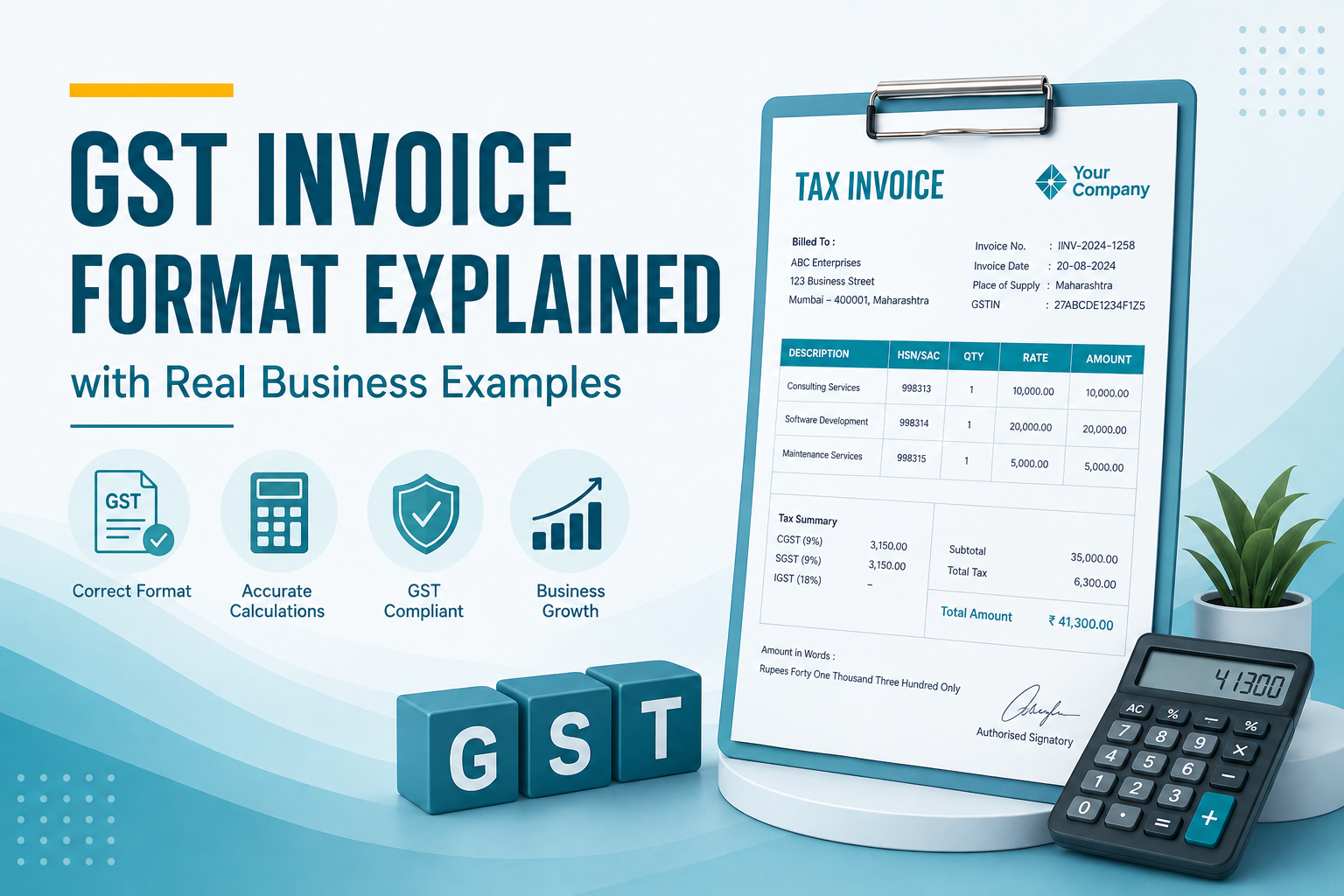
There's no getting around this part - a few things are simply mandatory. You'll need:
-
● Invoice number and date
-
● Supplier's name, address, GSTIN
-
● Buyer's details (GSTIN too, if they're registered)
-
● HSN or SAC code
-
● Description, quantity, and unit of goods/services
-
● Taxable value and total value
-
● CGST, SGST, or IGST breakup
-
● Place of supply
-
● Signature (physical or digital)
Skip one of these and technically the invoice isn't valid, even if everything else looks perfect. This is honestly why so many businesses eventually just switch to a GST invoice generator instead of typing invoices out in Word every single time - one missed field and you're redoing the whole thing.
B2B Invoice vs B2C Invoice - Where People Get Confused
Here's where a lot of first-time business owners trip up, so let's slow down a bit.
-
● B2B Invoice
A B2B invoice comes into play when you're selling to another GST-registered business. Since they'll likely use your invoice to claim tax credit, both GSTINs - yours and theirs - need to be spot on. Even a single wrong digit can throw off their GSTR filing, so this is one area where "close enough" really doesn't cut it.
Take this example: a fabric wholesaler in Surat sells material worth ₹2 lakh to a garment manufacturer in Ahmedabad. Since the manufacturer is registered, this is a textbook B2B invoice - and because it's crossing state lines, IGST applies instead of CGST/SGST.
-
● B2C Invoice
Now flip that around. A B2C invoice is what you'd issue to a regular customer walking into your shop - someone who isn't GST registered. You don't need their GSTIN here. Though if the sale crosses ₹50,000, especially for interstate transactions, you'll usually still note down their name and address just to be safe.
Simple example - a clothing store sells a ₹3,500 jacket to a walk-in customer. That's it, that's a B2C invoice. No extra GSTIN drama needed.
A Real (Small) Example
Let's say a stationery shop in a local market is billing a customer. Nothing fancy, just a GST invoice sample that covers the basics:
Invoice No: INV-2026-045
Date: 22-08-2026
Seller: Shree Stationery Mart, Surat - GSTIN: 24XXXXX1234X1Z5
Buyer: Walk-in Customer
|
Item |
HSN Code |
Qty |
Rate |
Taxable Value |
GST (18%) |
Total |
|
Notebooks |
4820 |
20 |
₹50 |
₹1,000 |
₹180 |
₹1,180 |
Fine for a small shop doing a handful of sales a day. But scale that up to fifty or a hundred invoices, across different states and tax slabs, and doing this by hand stops being realistic. That's usually the point where people start looking into GST billing software - something that fills in GSTIN details automatically, applies the right tax slab, and doesn't let you accidentally forget a field.
Don't Skip the HSN Code
The HSN code in invoice thing trips up more people than you'd expect. It's basically a classification code for goods (SAC for services), and depending on your turnover, you might need to mention 4, 6, or 8 digits of it. Get it wrong, and you could end up applying the wrong tax rate without even realizing - which is a mess to fix later.
A Few GST Invoice Rules Worth Remembering
Some GST invoice rules that are easy to overlook until they bite you:
-
● Invoices need to go out within a set time from the date of supply, not weeks later
-
● Invoice numbers should be sequential - no random skipping
-
● Goods being transported need original, duplicate, and triplicate copies
-
● If your turnover crosses the threshold, e-invoicing isn't optional anymore
None of these are complicated on their own, but miss one and it can delay someone else's tax credit - which isn't a great look for your business relationships either.
Why More Businesses Are Going Digital
Honestly, once your invoice volume goes up, manual formatting just becomes exhausting. A good GST invoice template through billing software takes care of tax calculations, keeps HSN/SAC codes handy, checks GSTIN validity, and often connects straight to your GST filing. Whether you're freelancing, running a shop, or handling wholesale orders, using a solid online invoice generator just makes life easier - less second-guessing, fewer errors.
Conclusion
At the end of the day, the GST invoice format in India isn't as intimidating as it first looks. Know what fields are mandatory, understand how B2B and B2C invoices differ, and get your HSN codes right - that covers most of what trips people up. And if manually building invoices every day feels like too much, tools built around the standard GST bill format can take a lot of that weight off your shoulders.
Frequently Asked Questions
Is the HSN code compulsory on every invoice?
Pretty much yes, though how many digits you need depends on your business turnover.
What's the real difference between B2B and B2C invoices?
B2B needs both parties' GSTIN since it's tied to input tax credit. B2C is for regular customers and skips the GSTIN requirement.
Can invoices be made manually, without any software?
Sure, as long as every mandatory field is there. It just gets tedious once your invoice numbers grow.
Is e-invoicing required for every business?
No - only for businesses that cross a specific turnover limit set by the government.
What happens if the invoice format is wrong?
Could mean rejected input tax credit, compliance notices, or trouble during a GST audit. Better to just get it right the first time.