Table of Contents1. Introduction |
|
Introduction
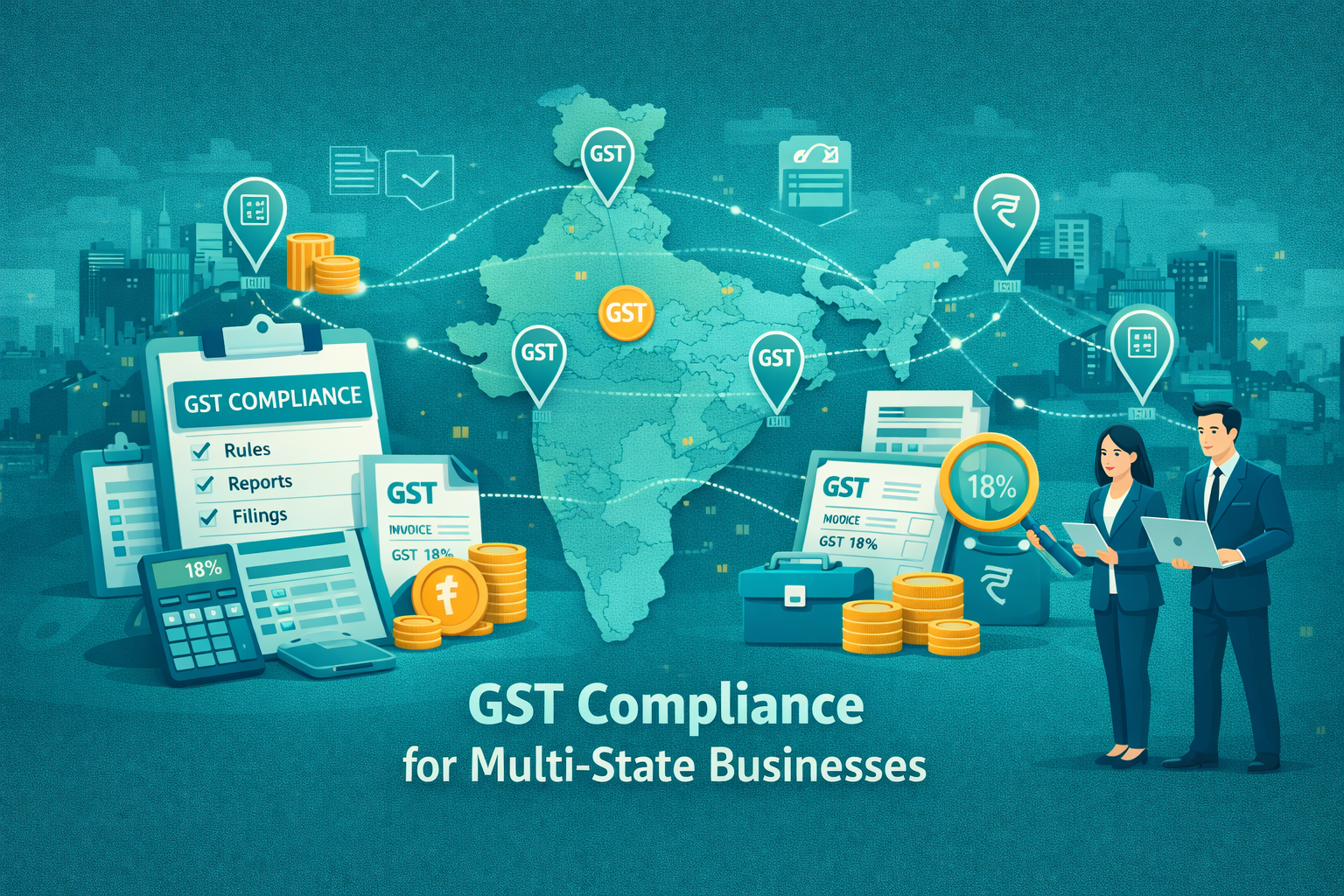
As your businesses expand across different states in India, GST compliance becomes more complex and structured. A company operating from multiple locations must manage several registrations, returns and tax rules at the same time. Without a clear understanding, even well-run businesses can face notices and penalties.
This is why GST compliance multi state businesses India requires special attention, especially for growing companies with branches, warehouses or offices in more than one state.
What Is Multi-State GST Compliance?
Multi-state GST compliance applies when a business has a physical presence or makes taxable supplies in more than one Indian state. Under GST law, each state of operation requires a separate registration even though the business entity remains the same.
With the updated Multi state GST registration rules 2026, authorities expect accurate state-wise reporting, proper invoicing and timely return filing for every GSTIN held by the business.
GST Registration Rules for Multiple States
The following are official GST rules that apply to businesses operating in multiple states. Check it out below:
-
● Separate GST registration in each state
A business must register for GST in every state where it has a branch, warehouse, office or fixed place of business.
-
● One PAN, multiple GSTINs
All registrations are linked to the same PAN but each state receives a unique GSTIN and is treated separately for compliance.
-
● Registration required even without sales
If goods are stored or dispatched from a location, GST registration is compulsory even if no sales occur there.
-
● Inter-branch transfers are taxable
Transfer of goods or services between branches in different states is treated as a supply and attracts IGST.
-
● Invoices must carry the correct state GSTIN
Using the wrong GSTIN on invoices can lead to penalties and denial of input tax credit.
-
● Returns must be filed for each GSTIN
Each state registration must file its own returns which makes managing GST returns multiple states an important operational responsibility.
-
● Input Tax Credit is GSTIN-specific
ITC earned in one state cannot be freely used in another without proper inter-branch documentation.
Common Mistakes Multi-State Businesses Make
Below are some common mistakes that can happen while handling multi-state business. Using an affordable GST tool for multiple businesses can help to tackle many of the below listed problems.
-
● Missing GST return deadlines for one or more states
-
● Applying CGST/SGST instead of IGST or vice versa
-
● Issuing invoices from the wrong state registration
-
● Mixing transactions of different branches
-
● Poor coordination between head office and state teams
-
● Relying only on spreadsheets for compliance tracking
Conclusion
As operations grow across states, manual GST handling becomes difficult and risky. Many businesses therefore start exploring the best GST software and buy it to manage compliance centrally and reduce errors.
With the right understanding of GST rules and proper systems in place, multi-state GST compliance becomes manageable and supports smooth business expansion across India.