Table of Contents1. Introduction |
|
Introduction
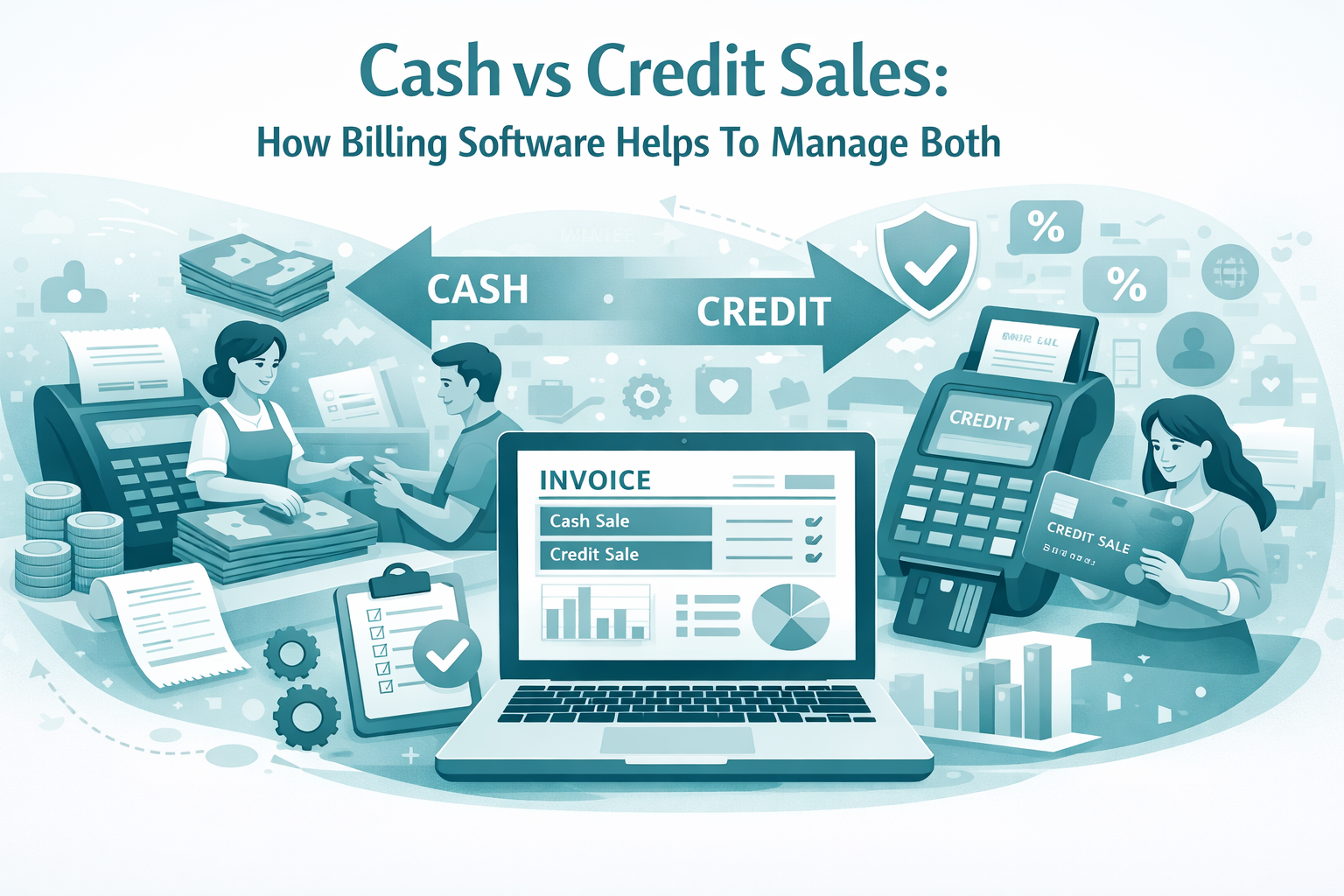
Every business always deals with the two main types of sales which is cash or credit sales, either retail, wholesale or service-based business. While both generate revenue, they can play a role in impacting cash flow and financial planning in very different ways.
This is where cash and credit sales billing software becomes important. A good system helps your business to record transactions accurately, track pending payments and maintain proper financial control. In this blog, we will understand the difference between cash and credit sales and see how the right software makes management simple.
Differences Between Cash & Credit Sales
Cash sales are transactions where payment is received immediately at the time of sale. The business person collects money instantly through cash, card or digital payment modes which also helps to improve immediate cash flow.
Credit sales, on the other hand, helps customers to purchase now and pay later. The payment is collected after an agreed credit period, such as 15, 30 or 60 days. While credit sales can increase customer loyalty and boost sales volume, they also create receivables that must be tracked carefully.
Because both types of transactions work differently, businesses need structured systems like cash and credit sales billing software to manage records properly.
Challenges in Managing Cash & Credit Transactions
Handling both cash and credit transactions together can be difficult especially. Without proper systems, errors and delays are common.
Using a proper billing software for cash and credit sales will help your business to avoid these issues and maintain clear financial records.
Some major challenges are given below for the same:
-
● Difficulty in tracking outstanding credit payments and due dates.
-
● Confusion between daily cash collections and pending receivables.
-
● Risk of bad debts due to poor follow-up.
-
● Manual calculation errors in ledgers and reports.
-
● Problems in GST reporting when sales types are not categorized correctly.
-
● Lack of real-time visibility into overall cash flow position.
How Billing Software Helps To Manage Cash & Credit Sales
Modern billing software is built to handle both types of transactions easily. A reliable cash and credit sales management system provides you multiple features that make the operations simple.
1. Separate Recording of Cash and Credit Transactions
Billing software clearly categorizes transactions as cash or credit which makes it easy to monitor daily collections and outstanding amounts.
2. Automatic Invoice Generation
With invoicing software for cash and credit customers you can generate instant bills for cash buyers and structured invoices for credit customers with due dates mentioned clearly.
3. Credit Limit and Due Date Tracking
Advanced credit sales tracking software helps you to assign credit limits to customers and receive alerts for overdue payments which reduces the risk of unpaid balances.
4. Real-Time Payment Updates
Once a customer clears payment, the system updates records instantly. This feature is common in small business billing software with payment tracking that will help you to make sure that the receivable reports are correct.
5. Integrated Accounting Reports
With the help of accounting software for cash and credit transactions you can generate profit & loss reports, receivable summaries and daily cash reports without manual calculations.
6. GST Compliance Support
A good GST billing software for cash and credit sales automatically calculates tax, maintains proper records and simplifies return filing.
7. Customer-Wise Ledger Management
Retailers benefit from retail billing software with credit customer feature, where each customer has a dedicated ledger showing purchase history and payment status.
So, when choosing the best billing software for small businesses, it is important to look for automation, ease of use and reporting capabilities.
Best Practices for Tracking Receivables and Cash Flow
A structured approach with the right system will help you to make better financial control and reduce payment delays.
So, even with software, you should follow certain best practices to maintain financial stability which are given below:
-
● Set clear credit policies and communicate payment terms to customers.
-
● Monitor receivable aging reports regularly.
-
● Send timely reminders for due payments.
-
● Reconcile daily cash collections with system records.
-
● Review customer credit limits periodically.
-
● Use automated dashboards to track real-time cash flow.
Conclusion
Managing both cash and credit sales is important for maintaining a healthy business. While cash sales improve immediate liquidity, credit sales help you to expand customer relationships and increase revenue opportunities. However, without proper tracking, credit transactions can create financial stress.
By using reliable cash and credit sales billing software, businesses can simplify billing, monitor receivables and maintain accurate records. The right system reduces errors, improves transparency and supports better decision-making.
In today’s competitive environment, it is important to invest in smart billing solutions. It is a necessity for sustainable growth and proper financial management.