Table of Contents1. Introduction |
|
Introduction
A few months back, my cousin opened a small stationery shop and asked me something that stuck with me: "Why do some products have that black line thing and others have the square dotted one? Do I need both?" I didn't have a perfect answer on the spot, honestly. I just knew they were different, but explaining why took some digging.
Turn out a lot of people mix these up, thinking QR codes are just a newer, fancier version of barcode. They're not. They're built for completely different job, and once that clicks, choosing between barcode vs qr code stops feeling confusing.
So here what I've learned, in plain language, no fluff.
Barcodes Have Been Around Forever
Seriously, since the 1970s. That pattern of black lines you see on almost every packaged item, that's a barcode. It's old tech, but it still works incredibly well, which is probably why nobody's rushed to replace it.
A barcode scanner reads those lines and turns them into a number. That number then pulls up info from a database, price, product name, stock count, whatever's stored there. Simple, fast, reliable.
There are a bunch of barcode types floating around depending on the industry:
UPC codes show up mostly in grocery stores and general retail. Code 128 gets used a lot in shipping and logistics. Code 39 is common in factories. And EAN codes are more of an international standard, especially across Europe.
None of these are drastically different from each other, they just cater to slightly different needs.
Then There's the QR Code
Now QR codes are a completely different animal. Those little square grids full of dots? You can't miss them anymore, they're on restaurant tables, event tickets, even random posters on the street.
-
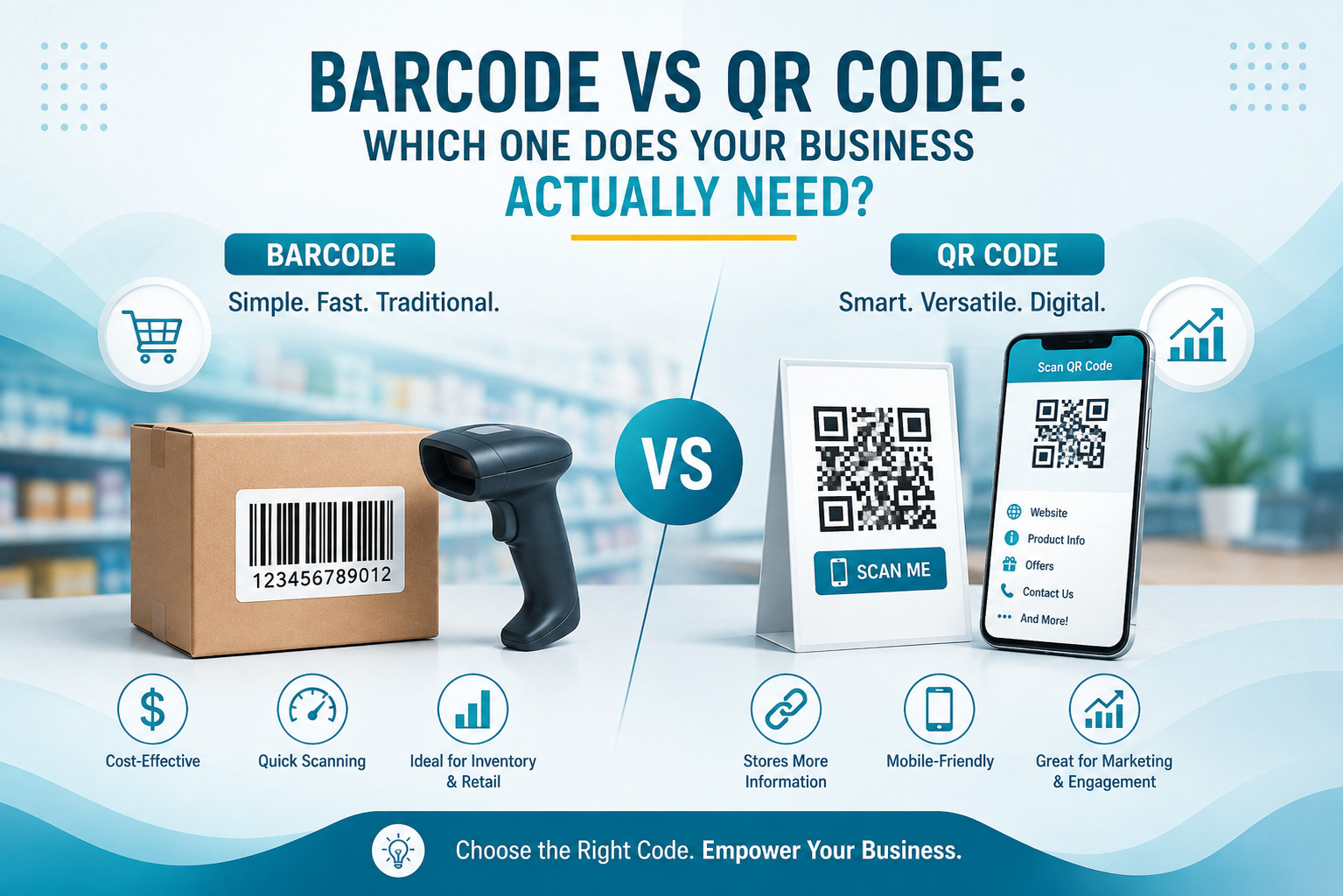
● The big difference is how much info they can hold.
-
● A barcode basically stores one number. A QR code can hold links, contact cards, payment details, sometimes even your Wi-Fi password.
-
● It's just a lot more flexible.
-
● And honestly, the reason qr code scanning blew up the way it did comes down to smartphones.
-
● You don't need any special equipment, just open your camera and scan.
That's exactly why restaurants switched to digital menus almost overnight during the pandemic, and why it just stuck around after.
Okay But What's the Real Difference Between Barcode and QR Code?
This is usually what people actually want to know when they search qr code vs barcode. Let me break it down without turning it into a robotic checklist.
-
● Storage-wise, barcodes are limited, they hold a short code, that's about it.
-
● QR codes can pack in way more, URLs, text, even small chunks of data.
-
● Scanning is different too. Barcodes usually need a dedicated scanner, especially in stores.
-
● QR codes work with basically any phone camera now, which makes them way more accessible for regular customers who aren't behind a checkout counter.
-
● Then there's what they're actually used for. Barcodes are the backbone of most barcode inventory management systems, warehouses, stockrooms, retail counters.
-
● QR codes lean more toward the customer side of things, marketing, payments, quick info sharing.
One thing that surprised me when I first learned it:
-
● QR codes can still get scanned even if part of them is damaged or covered up, because they have built-in error correction.
-
● Barcodes don't really have that cushion. Scratch up a barcode too much and it just won't scan.
Cost-wise, barcodes are usually cheaper and easier if you're just doing internal tracking. QR codes aren't expensive either, but depending on what you're linking them to, there can be a bit more setup involved.
When a Barcode Makes More Sense
If you're mainly worried about tracking stock, barcodes are probably your best bet. Both barcode and qr code setups can technically help with tracking, but barcodes were literally designed for fast, repetitive scanning, think busy checkout lines or warehouse shelves packed with products.
They tend to work best when you've got a large inventory with tons of different SKUs, when checkout speed actually matters, when you're already plugged into a POS or warehouse system built around barcode scanning, or when you just want something cheap to print in bulk without overthinking it.
When a QR Code Is the Better Call
QR code for business use has spread way beyond just retail stores at this point. Small cafes use them for menus. Real estate agents put them on "For Sale" signs linking to listings. Event organizers use them for check-ins. Even local gyms use them for class sign-ups now.
QR codes make more sense when you want customers to land directly on your website or social page, when you're setting up any kind of contactless payment or check-in process, when you want to share extra content like videos or reviews without cramming it onto the packaging, or when you're trying to connect your physical store with whatever you're doing online.
Using Both Isn't Weird, It's Actually Common
A lot of businesses run both at the same time, and honestly that's probably the smartest approach. You might have a barcode quietly doing the inventory work in the back, while a QR code sits right on the packaging linking shoppers to a product page or warranty registration. They're not competing with each other. They're just handling different parts of the job.
So Which One Do You Actually Need?
Here's the honest, no-fluff answer:
-
● It depends on what you're trying to fix.
-
● If your biggest problem is keeping inventory organized and moving fast through checkout, go with a barcode.
-
● If you're trying to connect with your customers, share more info, or bridge the gap between your shop and your online presence, a QR code fits that role a lot better.
A lot of businesses that grow past a certain point just end up using both anyway. Barcode in the back running the numbers, QR code up front doing the talking. There's really no rule saying you have to pick a side.
A Few Quick Questions People Usually Ask
Is a QR codes better than a barcode?
Not really "better," just different. QR codes hold more info and work great for marketing stuff. Barcodes are simpler and quicker for internal tracking.
Can any phone scan both types?
Pretty much, yeah. Most phones today handle both fine, though dedicated scanners are still faster if you're dealing with high volume in a retail setting.
Which one cheaper for a small business to set up?
Barcodes usually win here, especially if you've already got a scanner sitting around. QR codes aren't pricey either, just depends what you're linking them to.
Do QR codes eventually stop working?
Static ones don't expire, ever. But dynamic QR codes, the kind linked to editable content, can stop working if whoever's hosting the link shuts it down.
What's more reliable for actually tracking stock?
For serious inventory work, barcodes are still the go-to, especially in bigger warehouses and retail chains that need speed and consistency.