Table of Contents1. Introduction |
|
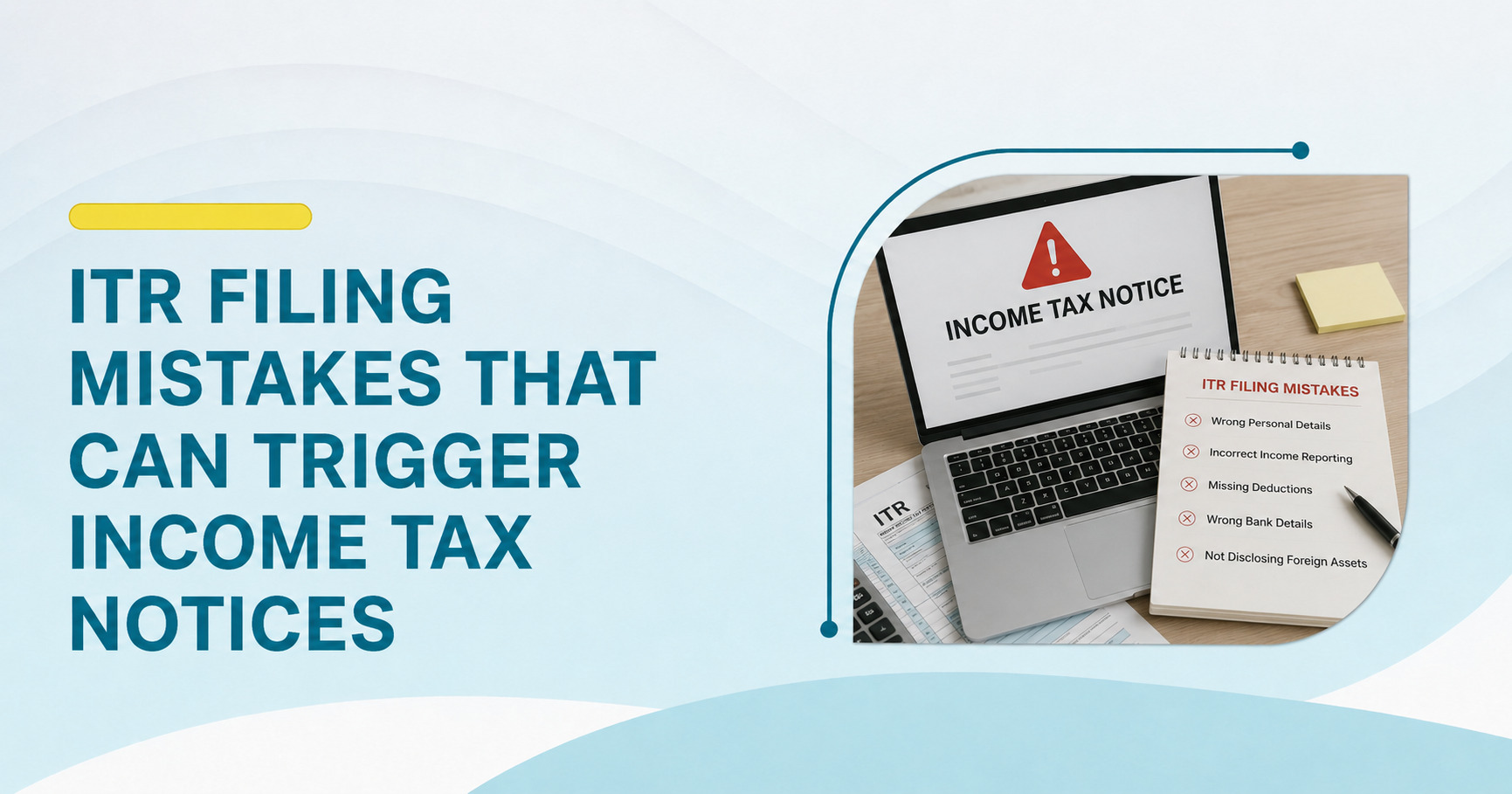
Introduction
Filing your income tax return feels like a relief - until an unexpected notice shows up in your inbox.
Most of the time it is not fraud. It is just a small error in ITR filing that the system caught automatically.
Today the Income Tax Department matches your return with bank, employer, and mutual fund data instantly. Even a small mismatch can trigger income tax scrutiny.
Let us look at the common ITR filing mistakes you should avoid this year.
ITR Filing Mistakes
-
● Wrong ITR Form - A Mistake People Still Make
-
● TDS Mismatch - The Most Common Trigger
-
● Underreporting and Misreporting of Income
-
● Capital Gains From Property Sale - Skipping This Is a Big Red Flag
-
● Claiming Unusually High Refunds Without Proper Basis
-
● What Happens When You Get a Notice?
Wrong ITR Form - A Mistake People Still Make
-
● Many salaried people pick up ITR-1 every year out of habit - without checking if they actually qualify for it.
-
● If you have capital gains, foreign income, or income above ₹50 lakh - ITR-1 is not the right form. Filing the wrong ITR form leads to an income tax defective return notice under Section 139(9).
-
● The consequences of filing a wrong ITR form go beyond just a notice. Your return gets treated as invalid - and if you miss the correction deadline, it is as if you never filed at all. Late fees and interest follow.
Always pick your form carefully before filing.
TDS Mismatch - The Most Common Trigger
This is probably the biggest reason people get noticed today.
Your Form 26AS and AIS carry all TDS data reported by banks and employers. When there is a TDS mismatch in 26AS versus your ITR, the system catches it instantly.
A 26AS and ITR mismatch can happen for simple reasons - maybe your employer filed a revised TDS return after you already filed, or you forgot to add FD interest income.
The result is usually an income tax demand notice 143(1). It looks scary but it is just a computer-generated alert. Still, ignoring it is a bad idea - it carries interest and can escalate quickly.
Always download your Form 26AS and AIS before filing. A TDS mismatch in ITR is completely avoidable with just a 20 minute check.
Underreporting and Misreporting of Income
This is where things get more serious.
Underreporting and misreporting of income is not always intentional. People simply forget to add freelance income, rent, savings account interest, or stock dividends. But the tax department already gets this data from banks and platforms like Zerodha or Groww - they know before you even file.
If a mismatch is found, it triggers an income tax scrutiny notice under Section 143(2) or an income tax notice section 142(1) asking you to explain the difference.
Intentional misreporting carries a penalty of 200% of tax evaded. Unintentional underreporting still brings a 50% penalty on top of tax due.
Neither is worth the risk - just declare everything honestly.
Capital Gains From Property Sale - Skipping This Is a Big Red Flag
-
● Many people think that since the buyer deducted TDS on the property deal, their job is done. It is not.
-
● Capital gains from sale of property not shown in ITR is one of the fastest ways to get a notice. The property registrar shares all transaction data directly with the Income Tax Department - they already know the sale happened and the value involved.
-
● Whether it is a flat, commercial shop, or agricultural land - the capital gain must be declared, the correct ITR form must be used, and the right tax must be paid or exemption claimed properly.
-
● If it does not show up in your return, questions will follow.
Claiming Unusually High Refunds Without Proper Basis
-
● Everyone wants a refund - but high income tax refunds that look disproportionate to your income do attract a second look.
-
● Claiming a large refund based on genuine TDS deductions or legitimate deductions under 80C, 80D, or HRA is completely fine. But if the numbers look off - or deductions seem inflated - it can trigger a manual review.
-
● This does not mean you should not claim what you are owed. Just make sure every claim has proper supporting documents ready before filing.
What Happens When You Get a Notice?
-
● Getting a notice does not mean you are in trouble. Most are simply system-generated alerts for specific mismatches.
-
● The defective return notice under 139(9) gives you 15 days to correct and refile. The income tax demand notice 143(1) gives you 30 days to either pay the demand or raise a correction if you think it is wrong.
-
● The key is simple - do not ignore any notice. Log in to the income tax portal, read it carefully, and respond within the given time.
Conclusion
Most ITR filing mistakes come down to rushing through the process. Taking an extra hour to cross-check your 26AS, pick the correct form, and declare all income sources can save you from months of back-and-forth with the tax department.
File carefully. File completely. And when in doubt, take help from a CA or tax professional - it is genuinely worth it.
Related Topics: